


tennis footwork drills
Tennis Footwork Drills That Actually Translate to Better Court Movement
You've done the ladder drills. You've run the cone patterns. You've put the work in before practice and stayed late after sessions. And yet, when a ball is hit to your backhand corner with pace, your footwork still breaks down. Your weight is back, your contact point is wrong, and the shot is defensive before you've even swung.
This is the problem most club-level and competitive tennis players face. They train footwork in isolation, then wonder why it doesn't show up in a match. The reason is almost always the same: footwork without positional awareness is just choreography. It looks right in a drill. It disappears under pressure.
The drills below are designed differently. They train movement the way the game actually demands it — reactively, with consequence, and with your body learning to find the right position instinctively rather than consciously.
Why Most Footwork Drills Miss the Point
Standard ladder and cone drills have value for developing raw speed and coordination. But they share a critical limitation: the pattern is known in advance. You see the cones. You know which way you're turning. Your brain is operating in planning mode, not reaction mode.
In a real match, you have no pre-knowledge. You're reading the ball, the opponent's body, the angle of their strings — all within milliseconds. Your footwork needs to be automatic, and more importantly, it needs to arrive in a mechanically sound position. Fast feet that put you in a compromised stance don't help you win points.
The most overlooked element in tennis footwork training is the split step and first-step quality. Most players split step too late, or not at all under pressure. When the split step is mistimed, every subsequent movement is reactive to the deficit rather than to the ball. You're always catching up.
Four Tennis Footwork Drills Built for Real Court Performance
1. The Reaction Ball Drop
Stand at the service line in your ready position. Have a partner drop a tennis ball from shoulder height from either side. Your job is to move, field the ball before the second bounce, and return to centre. The unpredictability of a bouncing ball forces genuine first-step reaction rather than anticipated movement. Do three sets of ten reps. Focus on the quality of your split step timing as your partner makes contact with the ground.
2. Shadow Footwork with Positional Holds
This drill removes the ball entirely. A coach or partner calls a court position — wide forehand, deep backhand, net approach — and you move to that position and hold for two seconds before recovering. The hold is the key. It forces your body to actually arrive in a balanced, loaded stance rather than rushing through the position. Most players discover immediately that they've been skimming through footwork patterns without ever landing properly.
3. The Five-Ball Directional Feed
Using a basket of balls, a feeder hits five consecutive balls to pre-called zones — but the calling happens as the ball is struck, not before. You must read and move simultaneously. This drill builds the connection between visual input and movement initiation that is essential for clay or hard court play where opponents can disguise direction.
4. Recovery Pressure Drill
After every groundstroke in a live rally, your coach places pressure on your recovery by feeding the next ball early, before you've fully reset. This isolates your recovery footwork and exposes whether you're genuinely recovering to a balanced ready position or just approximating it. Players who train this drill consistently develop faster, more efficient recovery paths across all surfaces.
The Role of Posture and Loading in Footwork Efficiency
Footwork is not just about your feet. The quality of your movement is determined largely by how well your hips, knees and core are loaded during every phase of movement and contact. A player who arrives at the ball with their weight back and hips high is going to produce a weaker, less reliable shot regardless of how fast their feet moved to get there.
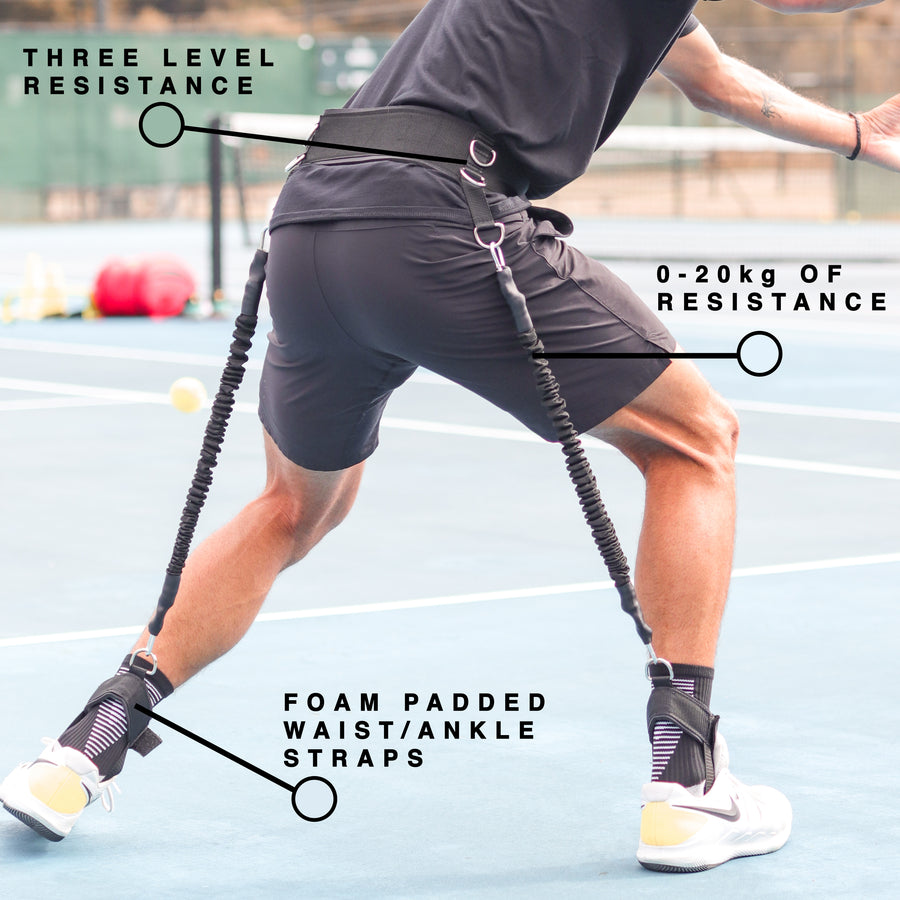
This is where many players find training tools like the Gravity Belt 2.0 by XPAND genuinely useful. It uses Reactive Neuromuscular Training to apply subtle resistance that reinforces correct athletic positioning — specifically, the low, loaded, forward-weighted stance that elite movers default to. When you train with it regularly, your body begins to associate movement initiation with proper positioning rather than treating them as separate concerns. The feedback is immediate and physical, which is how motor patterns actually change.
Players who address posture and loading alongside footwork drills tend to see faster improvements than those who train movement mechanics in isolation. The body learns position through repetition, and the quality of each repetition matters more than volume.
How to Integrate Footwork Training Into Your Weekly Practice
Footwork training works best when it's woven into technical practice rather than treated as a separate warm-up activity. Spend ten minutes per session on targeted movement work before live ball play begins. Use at least one of the reactive drills above rather than defaulting exclusively to ladder patterns. And during your groundstroke practice, make a conscious habit of evaluating your arrival position at contact — not just the outcome of the shot.
Progress in footwork is slow and often invisible until it isn't. Then one week you find yourself hitting a backhand winner from a ball you would have previously shanked, and you understand that the work accumulated.
If you're serious about building court movement that holds up in competition, explore how XPAND's Gravity Belt 2.0 fits into your training. It won't replace the drills. It will make every repetition count for more.