


How to Stay Low in Tennis and Why Most Players Never Crack It

How to Stay Low in Tennis and Why Most Players Never Crack It
You watch the professionals on clay and notice something immediately. They seem to glide. Every ball that drops into the court, they're already there, knees bent, body loaded, ready to strike. Then you look at your own game. You're reaching. You're standing too tall at contact. You're compensating with your arm instead of driving through the ball with your whole body. The problem isn't effort. It's structure.
Staying low in tennis is one of those fundamentals that sounds simple until you realise how much your body actively resists it. It takes more than knowing you should bend your knees. It takes building the habit into your movement patterns so deeply that you stop thinking about it altogether.
Why Players Stand Too Tall Under Pressure

Most club players drift upright the moment the rally gets fast. It isn't laziness. It's a natural stress response. When the pace increases, your body defaults to whatever position feels most comfortable and controlled. For most people, that's standing tall. The hips rise, the knees straighten, and suddenly you're playing an entirely different game to the one you intended.
The issue compounds because poor posture during a rally creates a chain reaction. When your hips are high, your weight shifts back. When your weight shifts back, your racket lags. When your racket lags, your timing goes. You start hitting defensively without realising your body put you there in the first place.
Staying low is not just about hitting technique. It is about your athletic base. The two cannot be separated. Players who move well do so because their default stance already puts them in position to strike. They're not dropping down as the ball arrives. They're already there.
What Staying Low Actually Means on Court
There's a common misconception that staying low means squatting deeply on every shot. That isn't practical or efficient. What it actually means is maintaining a slight, consistent bend at the knees and hips throughout the point, even between shots. This is your ready position. This is where your power and mobility come from.
Think about your split-step. If you land from a split-step with straight legs, you've already lost the advantage. A good split-step lands you in a loaded position, weight slightly forward, knees soft, ready to push in any direction. That loaded position is the same one you want to hold through the entire rally as your baseline.
The players who look effortless are not doing something magical. They've simply trained their body to treat a low, stable athletic stance as its resting state during a point. That takes deliberate, repeated exposure to the correct sensation until it becomes automatic.
How to Train Your Body to Stay Low Without Thinking About It

This is where training tools matter more than intentions. Telling yourself to bend your knees during a match is one thing. Training your nervous system to adopt that position instinctively under pressure is another entirely.
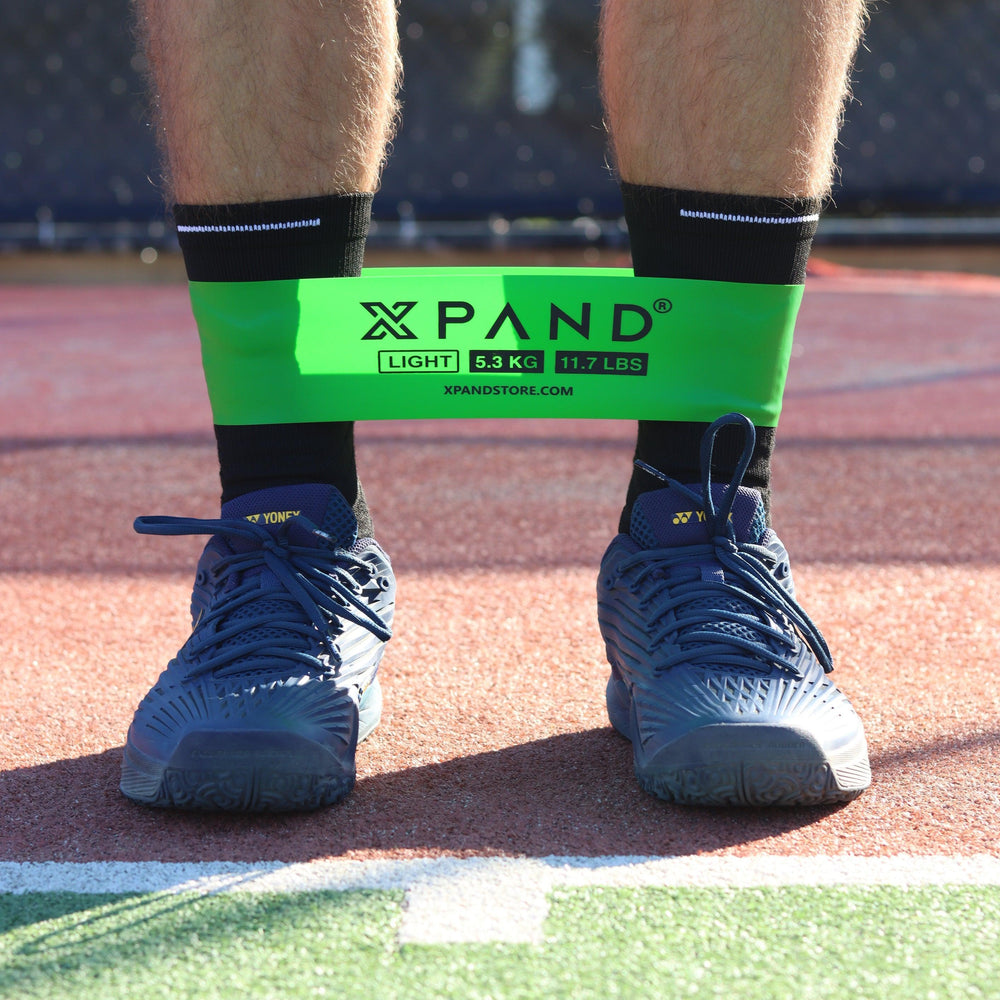
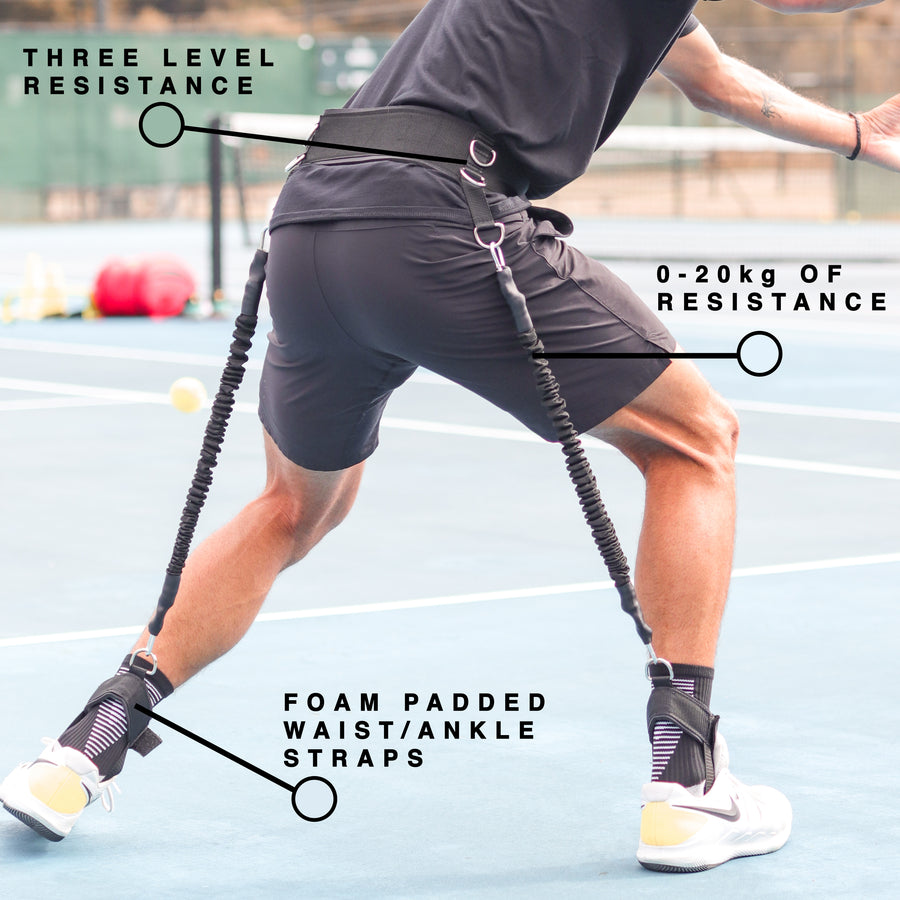
One of the most effective approaches uses Reactive Neuromuscular Training, a method that applies resistance to reinforce correct movement patterns. The Gravity Belt 2.0 works on exactly this principle. By applying light resistance around your waist during on-court drills, it creates subtle feedback every time your hips rise out of position. Your body learns to resist that upward drift without you consciously thinking about it. Over time, the low, athletic base becomes your default, not something you remind yourself to do.
You can pair this kind of resistance training with court drills that specifically target your ready position. Shadow footwork is useful here. Move through your groundstroke patterns without a ball, focusing entirely on maintaining consistent hip height across every step. Add the split-step, hold the landing position for a full second, then drive sideways. The goal is reinforcing what loaded movement actually feels like so you can reproduce it under match pace.
The Drills That Build a Lower, More Athletic Stance
Beyond shadow work, a few targeted drills directly address your ability to stay low across a full point.
Low Rally Counting: During practice rallies, count how many consecutive shots you complete with your hips below a certain height. You'll notice your posture drifting after three or four shots. Awareness comes first. Consistency follows.
Lateral Shuffle with Holds: Set up two cones about four metres apart. Shuffle laterally between them in a low stance, pausing for two seconds at each end in a loaded split-step position. This builds the muscular endurance your legs need to hold a low base for an entire set.
Feed and Hold: Have a partner feed balls to your forehand and backhand alternately. Your only job is to arrive at the ball in a low position before you swing. Do not worry about placement. Focus entirely on body position at contact. Most players are shocked at how often they arrive standing upright.
These drills are not complicated. The challenge is doing them with genuine attention to position rather than just hitting balls on autopilot.
Make It a Habit Before It Becomes a Problem
Most players only think about staying low after a coach points it out, or after a frustrating match where everything felt off but they couldn't explain why. The work happens in training, long before the match point pressure arrives.
Build a low athletic base into every warm-up, every drill session, every practice rally. Treat it as non-negotiable, the same way you treat your grip or your footwork. The players who move best on court didn't develop that quality accidentally. They trained it deliberately until it no longer required thought.
If you're serious about building that foundation, start with tools and methods that give your nervous system genuine feedback. That feedback is what turns an intention into a movement pattern. And movement patterns are what show up when the match is on the line.