


Pickleball Footwork Drills That Actually Improve Your Court Coverage

Pickleball Footwork Drills That Actually Improve Your Court Coverage
Most pickleball players who struggle at the net have the same problem. It is not their dinking technique. It is not their paddle angle. It is their feet. They arrive late, off-balance, or flat-footed, and the point is already half-lost before the ball even crosses the net.
Footwork in pickleball is undercoached because it is unglamorous. Players want to work on their third-shot drop or their erne. But the players who move well, who seem to always be in position, who rarely look rushed, they are doing something different at a foundational level. They have trained how to move, not just what to hit.
These drills target that gap directly.
Why Pickleball Footwork Is Different From Other Racket Sports

The pickleball court is small. That fools players into thinking footwork matters less. In reality, it demands more precision. The margins between good position and poor position are measured in inches, not feet. A player who drifts even slightly too far forward or too far back at the kitchen line will be exposed by a well-placed flick or a sudden speed-up.
Unlike tennis, where you have time to reset and recover, pickleball exchanges happen fast. The ball travels quicker relative to court size. You need to be in a low, ready athletic position almost constantly near the net. That is not a natural resting posture for most people. It has to be trained until it becomes automatic.
This is why drilling your footwork in isolation, separate from rallying, builds a different and more durable kind of movement habit.
Four Pickleball Footwork Drills Worth Repeating
1. Kitchen Line Shuffle Drill. Stand at the non-volley zone line in a low ready position. Have a partner or feeder alternately point left and right. Shuffle two steps in each direction, staying low, returning to centre each time. The goal is zero crossing of feet and no rise in your hips during the movement. Do three sets of thirty seconds. This drill directly trains the lateral coverage you need during dink exchanges.
2. Split-Step and Drive. Start at the transition zone. As your partner hits, perform a split-step, landing softly with bent knees, then drive forward toward the kitchen. The emphasis is on the quality of that split-step landing. Soft, balanced, immediately ready. Players who skip the split-step lunge instead of driving. That lunge costs them balance and time.
3. Cone Drop and Recovery. Place two cones roughly two metres apart near the baseline. Sprint to touch one cone, recover to centre, sprint to the other. The movement here trains direction change and the ability to decelerate without losing stability. As your conditioning improves, lower your base and add a bounce pass with a partner between each rep.
4. Backpedal to Reset. Start at the kitchen line. On a signal, backpedal to the transition zone and simulate a reset dink, then drive back forward. This trains one of the hardest movements in pickleball: retreating while staying composed enough to play a controlled shot. Most players panic when they are forced off the line. This drill removes that panic through repetition.
Training the Athletic Base That Makes Footwork Possible

Drills only work if your base position is solid. Many players perform footwork drills standing too tall. Their hips are high, their weight is back, and the moment they need to change direction, they are a step behind.
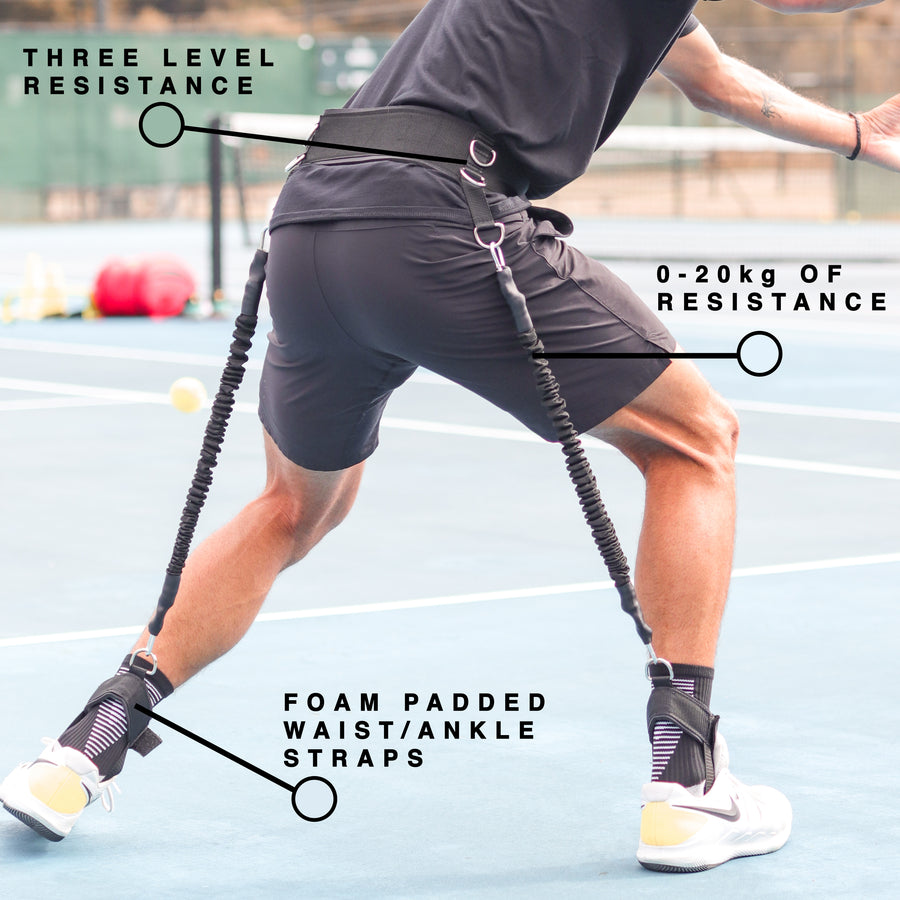
One tool that addresses this directly is the Gravity Belt 2.0. It uses Reactive Neuromuscular Training to create real-time resistance feedback when your posture breaks down. When you rise out of your athletic base, the belt responds. Over time your body learns, genuinely learns at a neuromuscular level, to stay low and stable as its default position. That is a different outcome from being told to stay low. It is your body finding the position itself.
Wearing it during your footwork drills does not just reinforce posture. It builds the kind of movement habits that survive pressure situations in actual match play, when you are fatigued in the third game and your technique starts to slip.
How Often to Train Footwork and What to Expect
Two dedicated footwork sessions per week, each around fifteen to twenty minutes, will produce noticeable changes within four to six weeks. The change you will feel first is composure. You will arrive at balls earlier. You will feel less rushed. Your shot quality in rallies will improve not because you changed your technique, but because your body is in better position to execute it.
This is the often missed connection in pickleball development. Players grind on stroke mechanics while ignoring the platform those strokes are built on. Fix the platform and the shots tend to improve on their own.
Footwork is not a warm-up activity. It is a core training discipline. Treat it that way and the results will reflect that.
If you are ready to take your movement seriously, start with the drills above and consider adding the Gravity Belt 2.0 to your training routine. It will change the way you feel on court faster than almost anything else.