


Why Your Padel Ready Position Technique Is Costing You Points Before the Rally Begins

Why Your Padel Ready Position Technique Is Costing You Points Before the Rally Begins
Most padel players lose points before they even swing. Not because of a poor shot, but because of where they are and how they are standing when the ball arrives. The ready position is the foundation of everything in padel. Get it wrong and you are always reacting late, always scrambling, always a half step behind your opponent.
This is not a beginner problem. Club-level and competitive players fall into the same traps repeatedly. A stance that is too upright. Weight sitting back on the heels. Knees barely bent. Arms passive and low. These habits feel comfortable, but they are quietly destroying your court coverage and your ability to generate clean contact on fast exchanges.
Understanding padel ready position technique is not about memorising a checklist. It is about building a body that defaults to the right position automatically, under pressure, every single time.
What a Correct Padel Ready Position Actually Looks Like

The ready position in padel is an athletic base, not a static stance. Your feet should be just wider than shoulder width. Knees bent with genuine intention, not a token flex. Your hips drop low, your chest stays tall, and your weight presses into the balls of your feet. This keeps you loaded and ready to move in any direction.
The paddle sits in front of your body at roughly chest height, held loosely with both hands. This shortens your reaction time enormously. When the paddle is hanging low or resting at your side, you are adding a full movement before you can even start your swing.
Your gaze is forward, tracking your opponents and reading the court. Your jaw is relaxed. Your breathing is controlled. The whole body should feel alert but not rigid. Tension kills speed in padel.
One more detail that separates good players from great ones: the split-step. As your opponent strikes the ball, you perform a small jump that lands exactly as the ball leaves their paddle. This reloads your base and allows you to explode in any direction. Without the split-step, your ready position is incomplete, no matter how good your stance looks.
Why Most Players Drift Out of Position During a Match
The problem is not that players do not know what the ready position looks like. Most have seen it demonstrated. The problem is that the body defaults to comfort under fatigue and pressure. Standing tall feels easier than staying low. Letting the paddle drop feels natural between points. These small drifts accumulate across a match and the result is slow reactions, poor court coverage and unforced errors on balls that should be controlled.
This is a neuromuscular issue as much as a technique issue. Your body needs to be trained to hold a low, stable athletic base as its default, not something you consciously summon when you remember to. That kind of deep postural habit requires more than drilling in a court session. It requires resistance-based feedback during training.
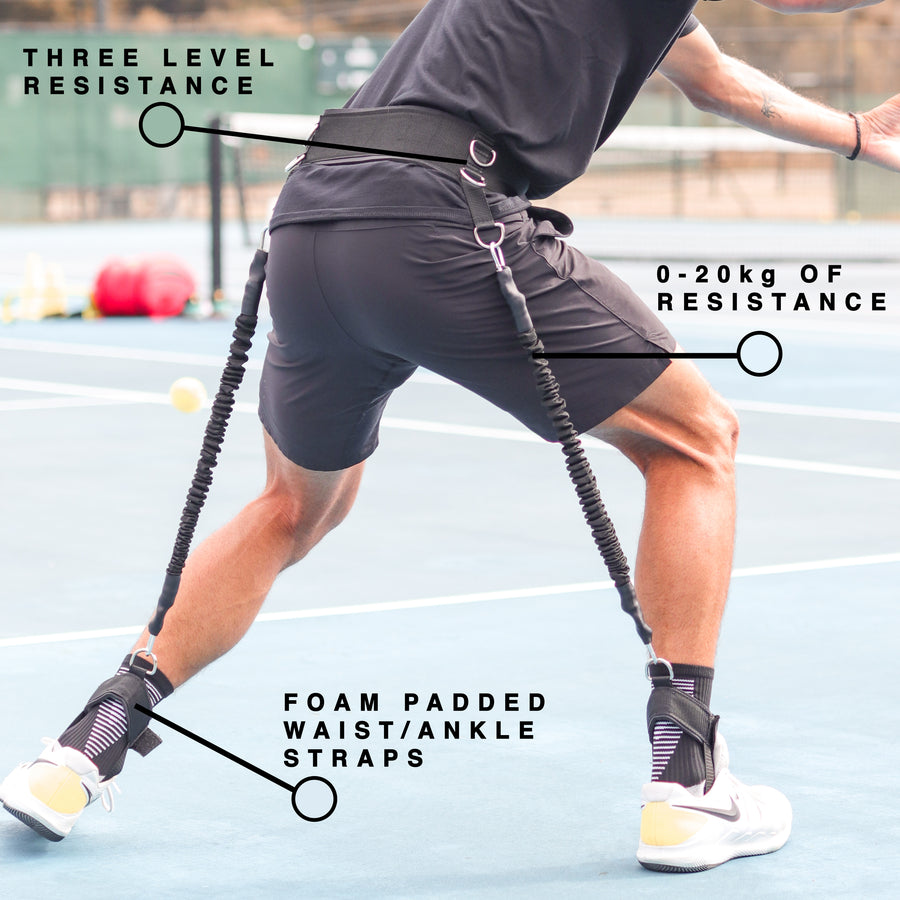
The Gravity Belt 2.0 from XPAND is built for exactly this. It uses Reactive Neuromuscular Training to apply subtle resistance that pulls you upright whenever your base collapses. Your body learns to resist that pull and hold a lower, more stable position instinctively. Over sessions, that low athletic base becomes the automatic default. On court it translates directly into faster movement, better balance and cleaner ball contact.
Common Mistakes That Break Down Your Ready Position

There are four mistakes that appear again and again at club and competitive level.
Heel loading. When your weight sits back on your heels, your first step in any direction is slow. You have to shift your weight forward before you can go anywhere. Players who heel load are consistently half a beat late on fast exchanges.
Passive arms. Letting the paddle drop between rallies adds time to every reaction. The paddle should stay elevated and in front of your body at all times when you are expecting the ball.
Standing too tall. An upright posture in padel is a losing posture. The low game demands a low body. Players who stand tall struggle with bandeja coverage, lob retrieval and any ball directed at their feet.
Ignoring the split-step. This is probably the most common gap at club level. Without the split-step timed to your opponent's contact, even a perfect static stance leaves you flat-footed when the ball arrives.
How to Build This Into Your Game for Good
Understanding the ready position intellectually is one thing. Owning it physically is another. The players who maintain elite posture and stance through long matches and high-pressure points are the ones who have trained it into their nervous system, not just their memory.
Start by filming yourself during practice or match play. Watch specifically for the moments when your stance collapses. It is almost always at the same moments: after a difficult rally, when you are fatigued, or when you feel comfortable and switch off between points.
Use resistance training tools that create body awareness without overloading your movement. Add specific split-step drills to every warm-up. Make it a habit before you ever hit a ball in a session.
Bring your coach into the conversation around posture and base. Many padel coaches focus heavily on technique for specific shots but undervalue the athletic foundation that makes all those shots possible. The ready position is not a footnote. It is the frame that everything else hangs on.
Start from the Ground Up
Padel rewards players who are ready. Not players who react after the fact, but players whose body is already loaded, balanced and primed before the ball arrives. That level of readiness comes from deliberate training of your athletic base.
Work on your ready position with the same focus you give to your bandeja or your volley technique. It deserves that attention. Because when you fix your foundation, every other part of your game improves with it.
If you want to make a low, stable athletic base your automatic default on court, explore how resistance-based training with tools like The Gravity Belt 2.0 can accelerate that process and turn a conscious habit into an unconscious one.