


Why Your Pickleball Ready Position Is Costing You Points Before the Rally Even Starts
Why Your Pickleball Ready Position Is Costing You Points Before the Rally Even Starts
Most pickleball players think about their ready position for about half a second. They bend their knees slightly, hold the paddle somewhere in front of them, and wait. Then the ball comes fast, or low, or wide, and they scramble. They blame their reaction time. They blame their footwork. Rarely do they trace it back to where it all begins: the stance they were in before the ball was even struck.
The ready position is not a passive state. It is an active, loaded, athletic foundation. Get it right and everything else, your split-step, your first move, your shot, becomes easier. Get it wrong and you are always one step behind.
What a True Athletic Ready Position Actually Looks Like
Stand with your feet roughly shoulder-width apart, maybe slightly wider. Your weight should sit in the balls of your feet, not your heels. Knees are bent and tracking over your toes. Hips are back and low, like the beginning of a squat. Your torso leans forward slightly, keeping your centre of mass over your base.
The paddle sits out in front, around waist height, held loosely but ready. Your eyes are up and tracking your opponent, not watching the floor.
That is the picture. But here is what most players miss: the depth of the hip hinge. Many players bend their knees without actually loading their hips. The result is a posture that looks athletic but has no real power behind it. When the ball comes, they have to generate movement from scratch rather than releasing tension that was already stored.
A low, hip-loaded position means your glutes and quads are under mild tension. You are coiled, not collapsed. That tension is what allows you to explode in any direction the moment you read the incoming shot.
The Connection Between Posture and Court Coverage
Poor ready position does not just hurt your reaction time. It changes the shots available to you entirely.
If you are standing tall when a dink comes low to your feet, you now have to drop quickly, adjust your paddle angle under pressure, and generate enough control to keep the ball in the kitchen. That is three problems compounding in under a second. A player already sitting low in a proper athletic stance only has one problem: directing the ball.
The same logic applies at the baseline. A high, upright stance leaves you slow to push laterally. Your first step is delayed. You are reactive in the worst way, responding to the ball rather than anticipating it.
Court coverage in pickleball rewards players who are already moving when most players are still deciding to move. That starts with the base you hold between every single shot.
Training Your Body to Hold the Position Under Fatigue
Knowing what a correct ready position looks like and actually holding it consistently through a full match are very different things. Fatigue is the enemy of posture. As rallies extend and legs tire, players unconsciously stand taller. The stance gets lazy. The hips rise. And suddenly the errors start stacking up in games three and four.
This is a training problem as much as a technique problem. Your body needs to be conditioned to maintain a low, stable base under load, and it needs proprioceptive feedback to know when it drifts.
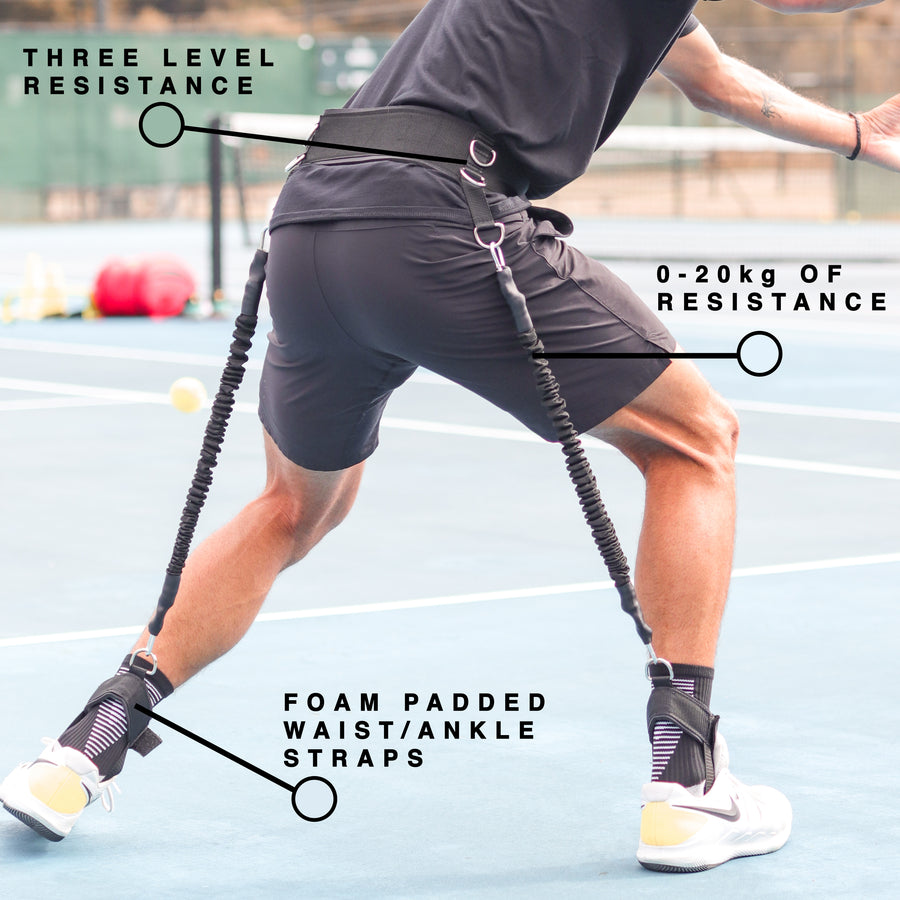
This is exactly the problem the Gravity Belt 2.0 was built to address. It uses Reactive Neuromuscular Training to apply resistance that pulls you out of a low position the moment you drift too high. Your nervous system learns, through repetition, where your base should sit. Over time, the correct stance stops being something you think about and starts being something your body defaults to, even under fatigue, even in the heat of a close game.
Training with it during footwork drills, dinking practice, or transition work builds the kind of muscle memory that holds up when points matter most. You are not just drilling a position. You are conditioning your body to own it.
Small Adjustments, Real Results
The gap between a decent pickleball player and a sharp one is rarely one big skill. It is usually a collection of small physical habits that compound over the course of a match. The ready position sits at the top of that list.
Start by checking in before every rally. Are your hips loaded? Is your weight forward? Is your paddle out and ready? These are quick questions but the answers shape every shot that follows.
Then take it into your training. Build drills that force you to hold your stance through lateral movements, rapid direction changes, and extended exchanges. The more you train the position under realistic conditions, the more automatic it becomes.
It is not a glamorous fix. There is no single drill that rewires everything overnight. But players who commit to building a proper athletic base find that their coverage improves, their errors reduce, and they feel less physically taxed at the end of long sessions. That is what a better ready position gives you. Not just better shots. A better relationship with the whole game.
If you want to build the kind of stable, low athletic base that holds up when matches get tight, explore how the Gravity Belt 2.0 fits into your training. It is one of the more honest investments you can make in your pickleball game.