


Why Junior Tennis Footwork Is the Skill Most Coaches Underestimate

Why Junior Tennis Footwork Is the Skill Most Coaches Underestimate
Ask most junior players what they need to improve and they'll say their forehand. Their serve. Maybe their mental game. Very few will say their feet. Yet footwork is almost always the real problem. A late arrival to the ball, a narrow base at contact, a sluggish first step after a wide ball. These are footwork problems dressed up as technique problems.
The hard truth is that junior tennis footwork shapes everything else on court. How well a player strikes the ball depends almost entirely on where their feet put them before contact. Fix the feet, and the technique often fixes itself.
What Good Footwork Actually Looks Like in Juniors

Good footwork in a junior player is not just speed. Speed without control is chaos. What you are really looking for is a combination of early movement, a stable base at contact, and efficient recovery back to position after every shot.
The split-step is where it all begins. A well-timed split-step, landing just as the opponent makes contact, loads the legs and primes the body to push explosively in any direction. Most juniors either skip it entirely or time it too early. When the split-step goes, the first step is always late. And a late first step means arriving at the ball off-balance, which forces rushed, poorly loaded groundstrokes.
From there, the ability to stay low through the movement phase matters enormously. Juniors tend to stand up as they travel to the ball. Their hips rise, their base narrows, and they end up reaching for shots rather than loading into them. This is not a strength issue at most junior levels. It is a movement habit that needs to be retrained deliberately.
The Postural Problem Behind Most Footwork Errors
When you watch a junior struggle with footwork, the issue often starts at the hips and base, not the feet themselves. Players who move upright during rallies cannot generate the lateral push or the low, loaded stance needed to strike with power and control. They are playing the game from the wrong height.
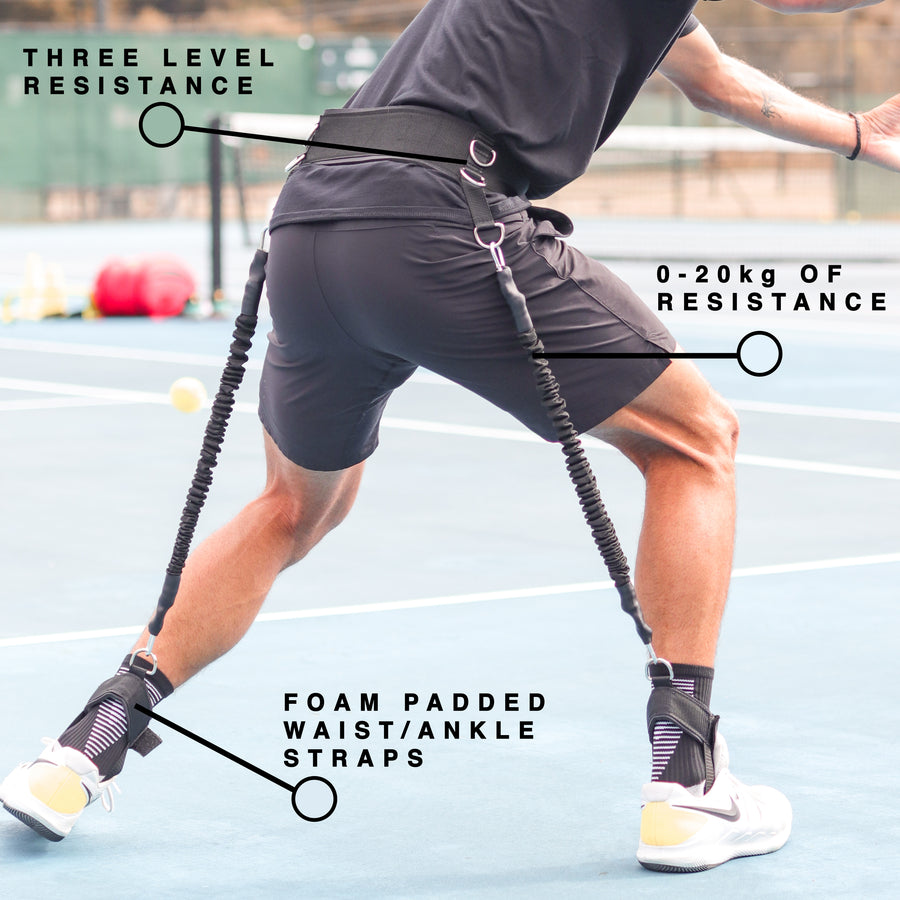
One training tool that addresses this directly is the Gravity Belt 2.0. It uses Reactive Neuromuscular Training to create feedback that reinforces a low, stable athletic base during movement. When juniors wear it during footwork drills, their body learns what a proper athletic position feels like under load. That physical awareness is far more effective than verbal instruction alone. Telling a junior to stay low works for about ten seconds. Giving them a training tool that makes the correct position feel natural works across an entire session.
This kind of proprioceptive training is particularly valuable at the junior stage, when movement patterns are still forming. Habits built now will carry through to competitive play. Habits left uncorrected become very expensive to fix later.
How to Train Junior Tennis Footwork Progressively

The mistake many coaches and parents make is treating footwork as a warm-up activity rather than a core training priority. Five minutes of ladder work before hitting is not footwork training. It is a ritual. Genuine footwork development requires structured progression, repetition under realistic conditions, and connection to actual shot-making.
Start with isolated movement patterns. Side shuffles, crossover steps, split-step drills without a ball. The goal here is to ingrain the mechanics before adding the complexity of ball tracking. Once the patterns feel automatic, introduce ball feeds so the junior is reacting and moving together. Then build into live play situations where they have to reset and recover after every shot.
Recovery footwork is perhaps the most neglected element in junior development. Getting to the ball is only half the job. Getting back to an effective court position after the shot is where many juniors give away easy points. Drilling recovery as a deliberate habit, not an afterthought, changes the way a player manages a whole rally.
The Long-Term Payoff of Investing in Movement Early
Junior players who move well have options. They arrive at the ball with time. They can choose their shot, load properly, and execute under less pressure. Players with poor footwork are constantly firefighting. They are chasing, reaching, and defending from positions their feet put them in.
The physical and neurological windows for building fluid, instinctive movement are widest during the junior years. A player who ingrains a proper split-step, a low athletic base, and efficient recovery patterns between the ages of ten and sixteen will carry those assets into every level of competition they reach. A player who skips that foundation will spend their adult career trying to compensate for it with racket work and tactics.
Footwork is not a secondary skill. It is the platform everything else is built on. Train it with the same seriousness you give to groundstrokes and serve mechanics, and the results on court will follow.
If you are working to build that foundation in a junior player, explore how the Gravity Belt 2.0 can accelerate the process. The best movement habits are the ones the body learns to own, not just follow.