


Padel Agility Drills That Will Transform Your Court Coverage

Padel Agility Drills That Will Transform Your Court Coverage
You lose points before the rally even ends. Not because your shots are weak, but because you arrive late. Half a step behind. Just out of position. In padel, that margin is everything. The court is small, but the demands on your movement are enormous. Angles change fast. Rallies flip direction in an instant. If your footwork is reactive rather than proactive, you will always be playing catch-up.
This is not a fitness problem. It is an agility problem. And agility, unlike raw speed, is trainable at any level.
Why Agility Matters More in Padel Than Raw Speed

Sprinting from baseline to baseline barely happens in padel. What happens constantly is short, sharp multi-directional movement. First step quickness. Rapid deceleration. Immediate reloading into a balanced stance. These are not the qualities you build by running long distances. They come from deliberate, specific agility work done close to the court surface.
The split-step is the foundation of all of this. Timed correctly as your opponent strikes the ball, it loads your legs and primes your body to explode in any direction. Most club players either skip it or perform it too late. Getting this one habit right alone will improve your court coverage noticeably.
From there, the goal is not just moving fast. It is moving fast while staying low and balanced enough to actually play a good shot. Height kills agility. Players who stand tall between shots lose ground every single rally.
Four Padel Agility Drills Worth Doing Regularly
1. The T-Drill. Set up three cones in a T shape roughly three to four metres apart. Start at the base, sprint to the centre, shuffle left to the outer cone, shuffle right across to the far cone, shuffle back to centre, then backpedal to the start. The key is to stay low throughout. Do not stand up when changing direction. This drill trains lateral quickness and deceleration, both of which are essential in padel.
2. Mirror Footwork with a Partner. Stand facing your partner roughly two metres apart. One player leads with random directional movement, the other mirrors. Keep it to short bursts of ten to fifteen seconds. This trains reactive agility, the kind that actually shows up in match play when you cannot predict the ball's direction in advance.
3. Box Shuffle to Split-Step. Use four cones in a small square. Shuffle around the outside of the box continuously, then at a random call from your coach or training partner, freeze into a split-step and hold a low athletic stance for two seconds before continuing. This trains you to layer the split-step into movement rather than treating it as a separate action.
4. Wall Feed Reaction Drill. Stand close to the padel wall. Have a partner feed balls unpredictably off the wall at varying angles. Your job is to react, move, and return each ball while maintaining a low base. This is as close to match conditions as agility training gets.
The Missing Piece: Training Your Athletic Base

Most players know they should stay low. Almost none of them do it consistently under match pressure. It is not laziness. It is a neuromuscular habit that has never been properly trained. Your body defaults to what feels natural, and for most people, standing upright feels natural.
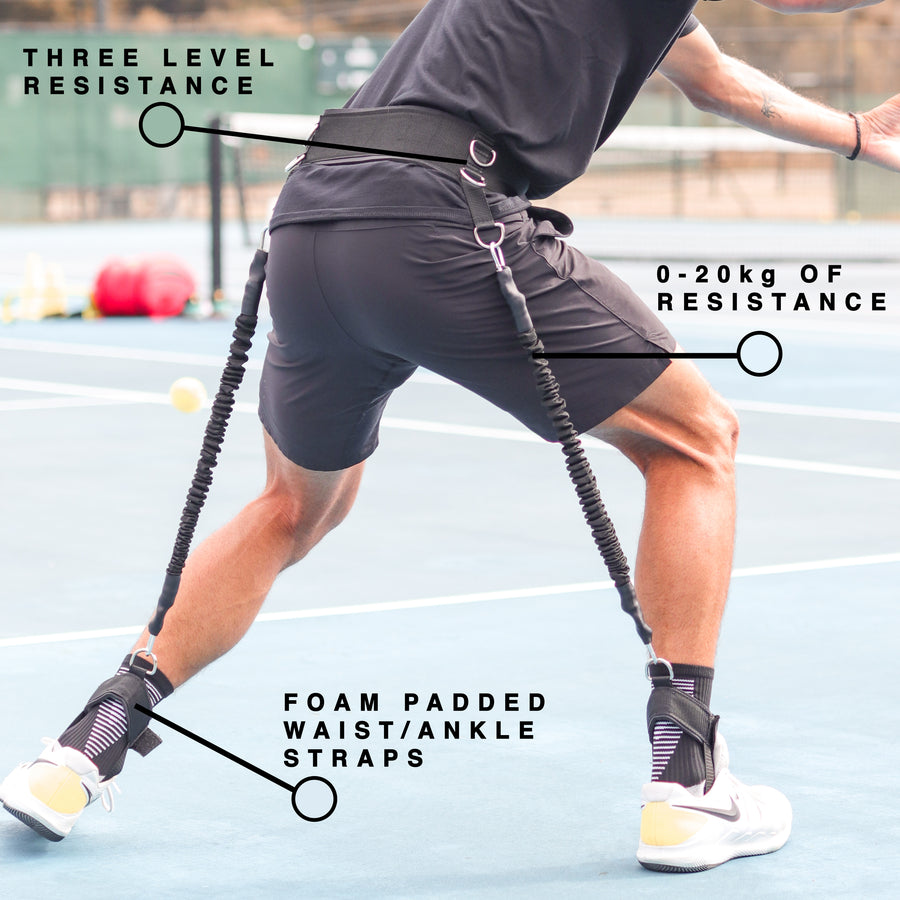
This is exactly the problem that the Gravity Belt 2.0 is built to solve. Using Reactive Neuromuscular Training, it creates gentle resistance that pulls you out of a low position the moment you rise too tall. Your body learns, through repeated feedback during movement, to hold that low athletic base automatically. Run your agility drills wearing it consistently, and you will start to notice that staying low stops feeling like effort. It becomes your default.
That shift is significant. In a long match, when fatigue sets in, players who have trained their base hold position. Players who have not start standing up, losing ground, and giving opponents easy angles.
Building Agility Into Your Weekly Routine
Agility training does not need to take over your schedule. Two focused sessions per week, fifteen to twenty minutes each, is enough to see real improvement over six to eight weeks. The key is quality over quantity. Sloppy repetitions reinforce sloppy movement. Every drill should be done with full intent and proper form.
Pair your agility work with on-court practice rather than treating them as separate categories. The best players integrate movement quality into everything they do. Feed drills, shadow footwork between points, deliberate split-step practice on every ball. Agility becomes automatic when it is practised in context, not just in isolation.
Progressive overload matters too. Once a drill starts feeling comfortable, add a time constraint, reduce rest periods, or introduce an unpredictable element. Your nervous system adapts quickly. You need to keep challenging it.
Move Better, Play Better
Better agility in padel is not about becoming an athlete. It is about removing the movement limitations that are quietly costing you points every match. The drills above are a genuine starting point. Apply them consistently, focus on staying low, and train the habits that hold up when the pressure is on.
If you want to accelerate the process and make your low athletic base feel automatic rather than forced, explore how the Gravity Belt 2.0 fits into your training. Small changes to how you move, compounded over weeks of good practice, produce results that feel significant on court.