


Gravity Belt Tennis Training: The Smarter Way to Build a Low, Stable Athletic Base
Gravity Belt Tennis Training: The Smarter Way to Build a Low, Stable Athletic Base
Most club players know they should be moving better. They've watched the footwork drills, they've heard the coach say "get low," and they've tried. But the moment a fast ball comes, the old habits return. The hips rise. The base narrows. The shot falls apart.
This is not a motivation problem. It is a motor pattern problem. And telling yourself to stay low does not fix a motor pattern.
That is exactly what gravity belt tennis training addresses. Not as a gimmick, not as a shortcut, but as a direct intervention into the way your nervous system learns to hold a position under pressure.
Why Verbal Cues Stop Working on Court
When you are rallying at pace, your conscious brain is already overloaded. You are reading the ball, tracking spin, deciding shot selection, and trying to recover position. There is no capacity left to also remind yourself to bend your knees.
This is why so many technically aware players still default to upright, passive stances during live play. The instruction exists in their mind. The body just does not follow it when things speed up.
Traditional resistance training builds strength, but it does not teach your nervous system where to hold that strength during specific athletic movements. That requires a different approach. It requires the body to feel the correct position, repeatedly, until it becomes automatic.
What Reactive Neuromuscular Training Actually Does
Reactive Neuromuscular Training, commonly referred to as RNT, works by applying external resistance in a way that challenges a movement fault in real time. The body responds by correcting itself, not because you told it to, but because the stimulus demands it.
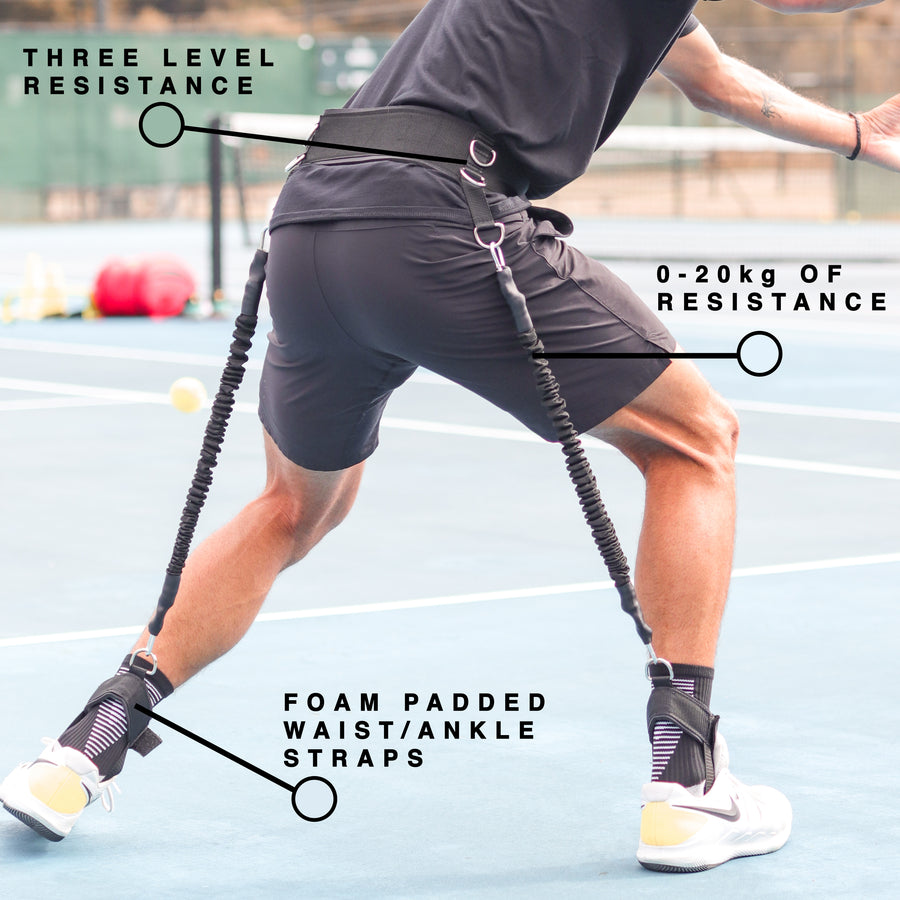
Applied to tennis, this means wearing resistance that pulls against poor posture or a high centre of gravity while you move, shadow swing, or perform court-based drills. Your body self-corrects to maintain balance. Over time, the corrected position becomes the default, even when the resistance is removed.
The Gravity Belt 2.0 is built specifically around this principle. It uses weighted resistance to challenge your base during movement, forcing your hips and core to stabilise at a lower, more athletic position. You do not have to think about staying low. The belt makes low the path of least resistance.
That shift matters enormously for tennis. A stable, low base is not just about aesthetics or looking like a pro. It is the physical foundation for everything else: better split-step timing, faster lateral recovery, cleaner contact on low balls, and greater consistency under pressure.
How to Use Gravity Belt Training in a Tennis Context
The mistake most players make is treating resistance tools as something to wear during a full practice session from the start. That tends to produce fatigue before adaptation. A more effective approach is targeted integration.
Start with shadow movement. Put the belt on and walk through your standard movement patterns: the split-step, the cross-step, the recovery shuffle. Focus on how the resistance changes the way you hold your hips. Notice where you tend to rise up. Let the belt guide you back down.
Next, move into controlled feeding drills. Have a partner feed from close range while you focus purely on footwork and stance, not on winning the point. Short, frequent repetitions work better here than long rallies. The goal is groove, not competition.
Once you feel comfortable, introduce live ball play for short blocks of five to ten minutes. Then remove the belt and play without it. Most players notice immediately that their base feels lower and more controlled, even without the resistance. That carry-over effect is the point of the entire exercise.
Three sessions per week over four to six weeks is enough for most club-level players to notice a meaningful shift in their court presence and movement confidence.
The Performance Outcomes Worth Training For
It is worth being clear about what this kind of training actually changes on court, because the benefits are not always obvious until they accumulate.
First, contact quality improves. A lower, more stable base means your body arrives at the ball in a position to actually use your legs in the swing. Groundstrokes feel cleaner. You stop hitting off your back foot as often.
Second, recovery speed increases. When your centre of gravity is already low, your first step out of a shot is faster. You are not wasting time sinking into position. You are already there.
Third, consistency under pressure holds up better. High-pressure points tend to expose postural weaknesses. A properly trained base does not collapse when the stakes rise. The motor pattern holds because it was built to hold.
These are not dramatic transformations that happen overnight. They are the kind of quiet improvements that show up over a season and make you wonder why you were ever playing so upright.
Start Building the Base Your Game Deserves
If your movement feels effortful, if you struggle to stay low late in a match, or if your coach keeps repeating the same postural cues without lasting results, the problem likely lives in your nervous system, not your effort levels.
Gravity belt tennis training offers a direct, evidence-based way to address that. Not through more instruction, but through the kind of physical feedback that actually produces lasting change.
If you are serious about building an athletic foundation that holds up when it counts, the Gravity Belt 2.0 is worth exploring as a structured part of your training week. Your movement will thank you for it.