


How Serious Tennis Players Can Improve Tennis Court Coverage Without Running More

How Serious Tennis Players Can Improve Tennis Court Coverage Without Running More
You already train hard. You put in the hours. But somehow, balls that should be reachable are still getting past you. Your opponent is not necessarily faster. They are just better positioned. And that difference, small as it sounds, decides matches at every level from club finals to regional competition.
Improving your tennis court coverage is rarely about raw speed. It is about the decisions your body makes before you consciously think to move. Anticipation, balance, and the quality of your first step matter far more than how fast you can sprint over five metres.
This is where most players train the wrong thing.
Why Most Footwork Training Misses the Point
Ladder drills are everywhere. Cone circuits, shuttle runs, agility courses. These tools have their place. But they train isolated movement patterns in predictable sequences. On court, nothing is predictable.
Real court coverage starts with your base position. Where your weight sits between shots, how your hips are loaded, whether your knees are over your toes or collapsed inward. These details determine how quickly you can push off in any direction. If your base position is slightly off, every movement you make from it costs you time.
Most players never receive feedback on this. They repeat the same movement patterns in practice, reinforce the same inefficiencies, and wonder why their court coverage does not improve despite consistent training.
The body learns through repetition. The problem is it does not distinguish between good repetition and poor repetition. It simply locks in whatever you practise most.
The Role of Athletic Position in Reaching More Balls
Stand in a ready position right now. Where does your weight feel? If it is sitting back through your heels, you are already slower than you need to be. A proper athletic stance loads the balls of your feet, keeps the hips hinged, and positions the knees tracking over the second toe.
From this position, your first step is explosive. Your momentum is already leaning into movement. You cover the same distance with less effort and arrive at the ball with more time to prepare your shot.
From a heel-heavy or upright stance, you lose a fraction of a second on every single ball. Over a three-set match, that adds up. Wide balls become scrambles. Comfortable balls become rushed. Your shot quality drops not because your strokes are poor but because you are always a little late.
Correcting your athletic stance is the single highest-leverage change most club and competitive players can make to improve tennis court coverage. The challenge is that incorrect positioning feels normal. It is your default. Telling yourself to stand differently rarely works beyond the first few minutes of a session.
Training the Body to Self-Correct in Real Time
This is where Reactive Neuromuscular Training changes the conversation. Rather than relying on conscious reminders or coach cues mid-rally, RNT uses physical resistance to create an automatic correction response. When your body moves out of alignment, it feels it immediately and adjusts.
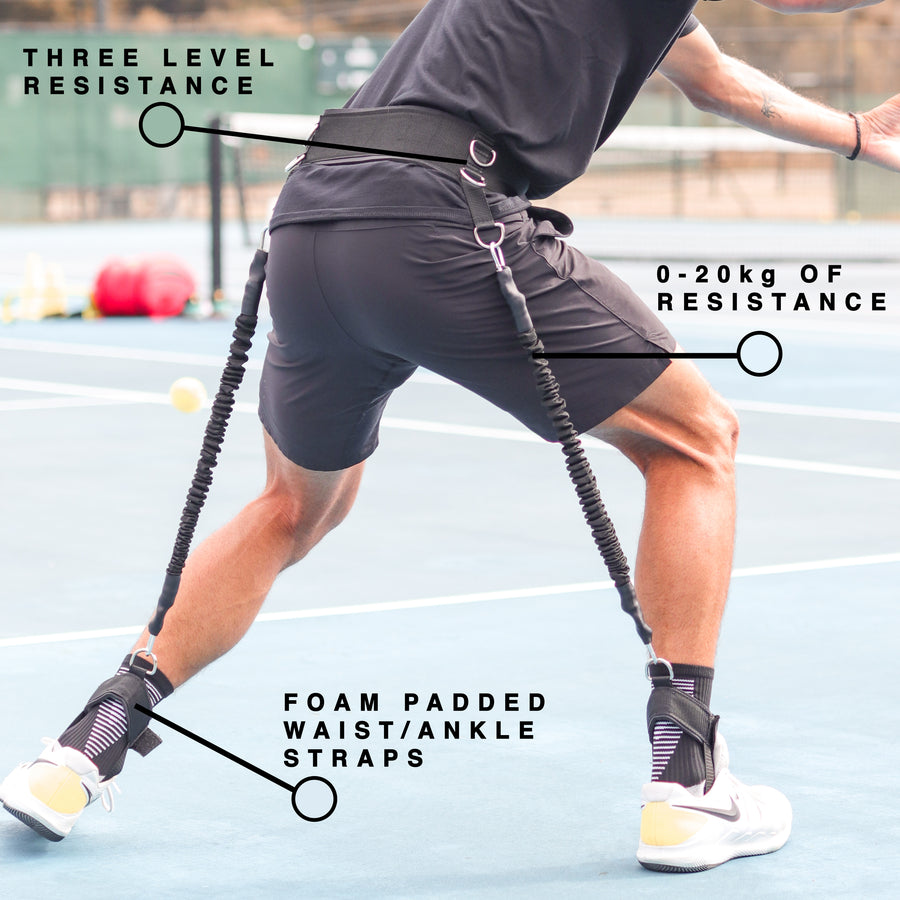
The Gravity Belt 2.0 was built around this principle. Worn around the hips during on-court practice, it creates tension through your movement patterns that reinforces correct athletic positioning. When your knees collapse inward or your weight shifts back, the resistance makes that misalignment tangible. Your neuromuscular system responds. Over time, the correct position becomes the default position, even when the belt is off.
This is not a corrective brace. It is a training tool that accelerates the process of building better movement habits. Players using it during footwork drills and live rally practice are not just moving better in training. They are moving better in competition, because the patterns have been wired in at a deeper level than conscious thought can reach.
The difference shows up in the moments that matter. A wide forehand you read early. A split-step that actually loads you in the right direction. A recovery after an attacking shot that gets you back into position before your opponent can exploit the open court.
Practical Steps to Start Moving Better This Week
You do not need to overhaul your entire training programme. Start with these three things.
First, audit your ready position. Film yourself from the side during a rally or a hitting session. Watch where your weight sits and whether your hips are loaded. Most players are surprised by what they see.
Second, make your split-step a non-negotiable. Every shot your opponent makes should trigger a small hop that lands just as they make contact. This re-loads your legs and keeps you reactive rather than static. It sounds simple because it is. But most players do it inconsistently, especially late in a match when fatigue sets in.
Third, add purposeful movement work to at least two sessions per week. Not fitness running. Court-specific movement drills that replicate the patterns you use in points: recovery steps, direction changes, approach movements. This is where a tool like the Gravity Belt 2.0 earns its place, reinforcing position quality through every repetition rather than letting fatigue slide your mechanics back into old habits.
Court coverage is a skill. Like any skill, it responds to smart, consistent practice. The players who seem to glide around the court are not gifted with exceptional speed. They have built movement habits that make positioning look effortless.
You can build the same thing. It starts with understanding that the problem is not your fitness. It is your foundation.
If you want to move better and reach more balls without simply running more, explore how the Gravity Belt 2.0 fits into your training. The details are on the XPAND website.