


tennis footwork drills
Tennis Footwork Drills That Actually Translate to Better Play on Court
You've put in the hours. You're consistent from the baseline, your serve is reliable, and your technique holds up in practice. But when a match gets tight, when the ball is hit a half-step behind you or pulled wide with pace, something breaks down. You arrive late. Your balance is off at contact. The shot you've grooved a thousand times suddenly has no authority behind it.
Most players blame their hands. The problem is almost always their feet.
Footwork in tennis isn't just about speed. It's about arriving in the right position, in the right athletic stance, at the right moment. The gap between good players and great ones isn't usually technical. It's spatial. It's how efficiently they move to the ball and how well they're loaded when they hit it. That's what these tennis footwork drills are designed to address.
Why Most Footwork Drills Don't Transfer to Match Play
The standard cone drill or ladder sequence has a place in training, but it has a significant limitation. When you run a predetermined pattern, your brain already knows where your feet need to go. You're executing memory, not making decisions. Match play is constant decision-making under physical and mental pressure.
Effective footwork training needs to do two things simultaneously. It needs to build the physical movement patterns you want to become automatic, and it needs to train your body to hold proper athletic position throughout those movements. Most drills do the first. Almost none do the second.
The result is players who move quickly but arrive unbalanced, weight too far forward, hips too high, outside of their base at contact. Speed without structure is wasted movement.
The Four Footwork Patterns Every Tennis Player Must Own
Before adding complexity to your drill work, make sure these four movement patterns are genuinely clean and automatic.
The split step: Timed precisely with your opponent's contact, the split step is the foundation of reactive movement. Land with your weight centred and knees bent. If you're landing stiff or late, everything that follows is compensatory.
Crossover steps for wide balls: The first step to a wide ball should be a crossover, not a lateral shuffle. It covers more ground more quickly. Most club players default to shuffling because their first-step explosiveness is underdeveloped. Drill crossover steps with a strong athletic base and a deliberate weight transfer into the first stride.
Recovery steps: Getting to the ball is only half the equation. Where you recover to and how quickly you do it determines your options on the next shot. Practice recovering to your base position with the same intensity you use to move toward the ball.
The loading step into contact: This is the step that most players neglect entirely. The final adjustment step before contact should lower your centre of gravity and load the outside hip. It's what creates leverage, balance, and transfer of weight through the shot. Without it, you're hitting with your arm, not your body.
Tennis Footwork Drills Worth Adding to Your Practice
Spider drill with held positions: Run the standard spider drill across the baseline, but at each cone, pause in your ready position for two full seconds before moving to the next. This forces you to genuinely load and stabilise rather than simply touch and go. It's uncomfortable if you've never trained this way. That discomfort is the point.
Feed and recover: Have a partner or coach feed balls to alternating sides with a tight recovery window. The constraint here isn't speed. It's that you have to arrive balanced enough to execute a controlled shot, not just get the racket on the ball. If your shots are breaking down, your footwork is breaking down first.
Reactive split step training: Stand at the service line. A feeder holds a ball at racket height and drops it without warning. Your job is to split step at the moment it leaves their hand and push laterally toward a designated cone. The emphasis is on timing and first-step direction, not overall speed.
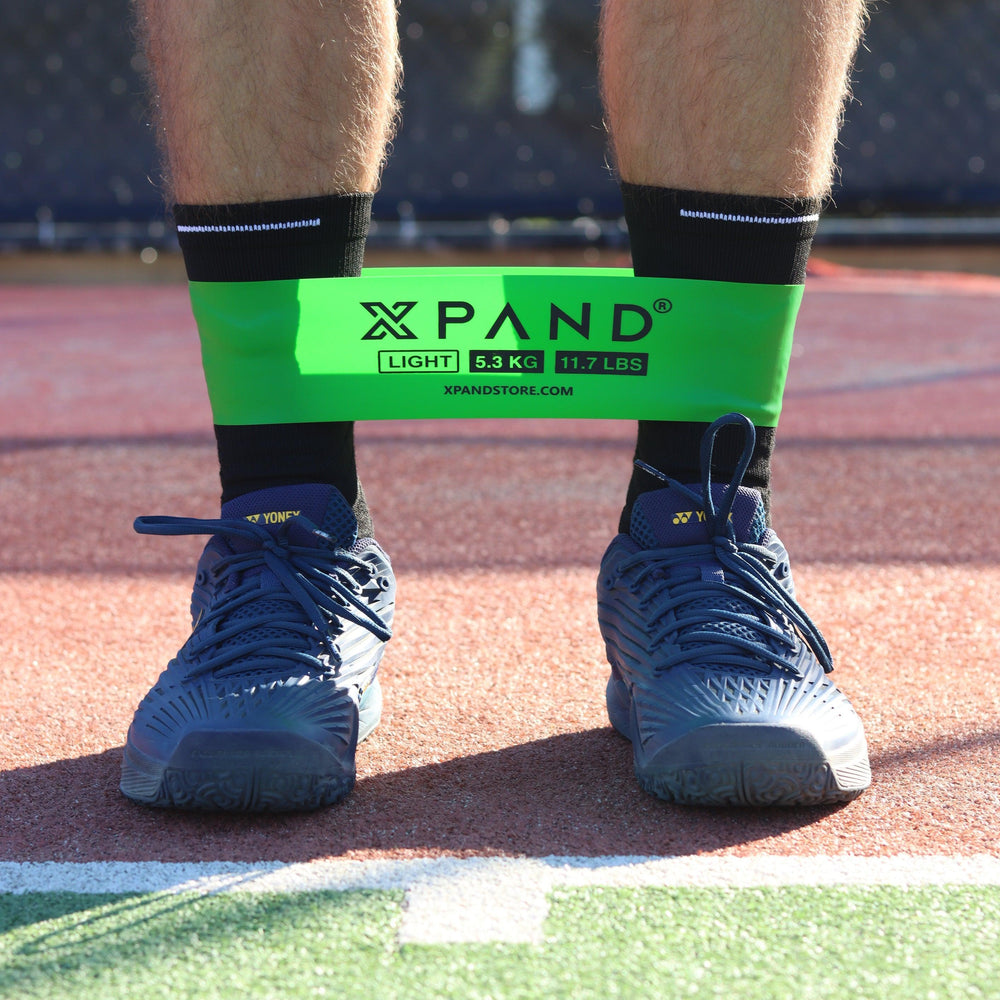
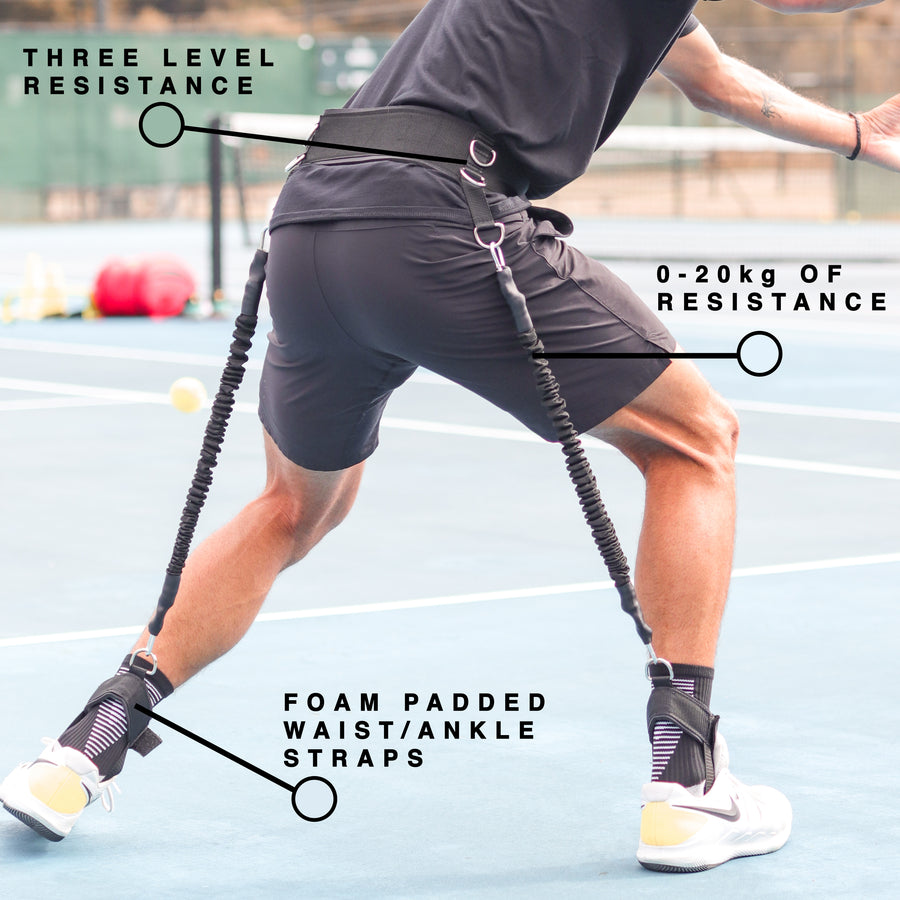
Resistance-based movement patterns: This is where training tools that provide external feedback become genuinely valuable. The Gravity Belt 2.0 uses Reactive Neuromuscular Training principles to create resistance that activates and reinforces correct athletic positioning during movement. When you move into a poor base or let your hips rise under fatigue, the belt creates immediate sensory feedback that trains your neuromuscular system to self-correct. It's not a shortcut. It's a way of making your footwork practice more specific, so the patterns you're building are the right ones from the start.
Building Footwork Habits That Hold Under Match Pressure
The reason good footwork breaks down in matches is not fitness, and it's usually not knowledge. Players know they should split step. They know they should load before contact. The problem is that these patterns haven't been trained to the point where they survive pressure, fatigue, and the cognitive load of actually competing.
That threshold is only reached through high-quality repetition. Not volume alone, but repetitions where the positioning is correct, where the body is being trained to reinforce good movement rather than ingrain compensations.
Train your footwork the way you'd train any technical skill. Break it into components. Drill it with intention. Hold the positions that matter. Then build back to full pace once the pattern is clean.
If you're serious about your movement on court, every practice session should include some dedicated footwork work, and that work should be specific enough to actually change how you move under pressure.
If you want to understand how the Gravity Belt 2.0 supports this kind of neuromuscular footwork training, explore how XPAND approaches movement development for competitive players.