


The Tennis Ready Position Is Holding Your Game Back (Here Is Why)

The Tennis Ready Position Is Holding Your Game Back (Here Is Why)
You have watched the professionals do it a thousand times. Between every point, before every return, in that half-second window before the rally begins, the best players in the world settle into something that looks almost effortless. Knees bent. Weight forward. Eyes level. Body coiled and ready to move in any direction.
Now think about what you do in that same moment.
For most club-level and competitive players, the tennis ready position is something they learned once and never revisited. It sits in the background, assumed rather than trained. And that assumption is quietly limiting almost everything else in your game.
What the Ready Position Actually Does

The ready position is not just a stance. It is a loading mechanism. When your hips are hinged correctly, your knees are tracking over your toes, and your weight is distributed through the balls of your feet, your body is preloaded for explosive movement. Every split-step you take, every first step toward the ball, begins from this foundation.
Get it right and your reaction time improves, your first step is sharper, and your groundstrokes generate more effortless power because your kinetic chain is connected from the ground up. Get it wrong and you are compensating before the point has even started.
The most common fault is deceptively simple. Players stand too upright. The knees barely bend, the hips sit back or lock out, and the spine tilts awkwardly forward from the upper back instead of hinging cleanly at the hip. It looks fine from the stands. On court, it costs you milliseconds on every ball and places chronic strain on your lower back over time.
Why Most Players Cannot Feel the Problem
Here is the uncomfortable truth. If you have been playing in a compromised ready position for months or years, it feels normal. Your nervous system has accepted it as the baseline. Telling yourself to bend your knees more rarely changes anything beyond a single drill, because the body defaults to what it knows under pressure.
This is not a technique problem. It is a proprioception problem. Your body's internal map of where it is in space does not match reality, and no amount of conscious effort fully corrects that in a live match situation.
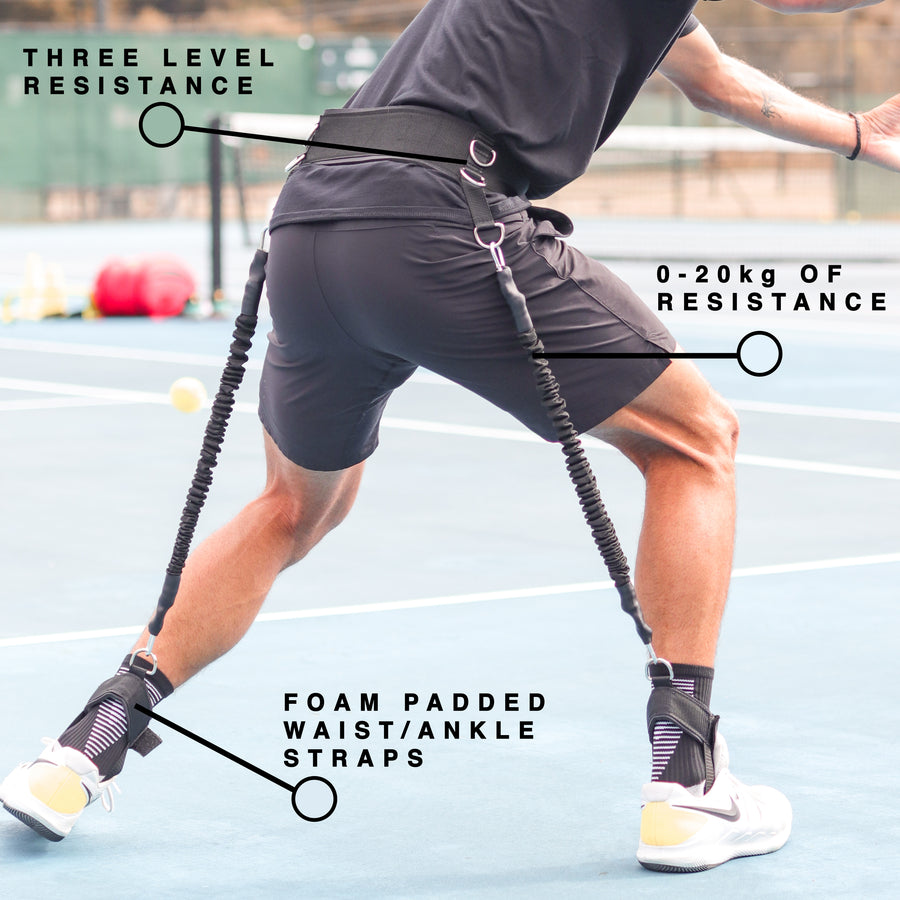
This is exactly the gap that Reactive Neuromuscular Training addresses. Rather than relying on willpower or external feedback from a coach shouting across the court, RNT uses resistance to create an automatic correction. When your body begins to drift out of position, the resistance pulls against that drift and your nervous system responds by recruiting the right muscles to stabilise. Over time, that correct position becomes the pattern your body defaults to, even under competitive pressure.
The Gravity Belt 2.0 was built around this principle. Worn during on-court training, it applies controlled resistance that challenges your hip hinge and low-back position in real time. Players do not need to think about their ready position. They feel when it breaks down, and the body learns from that feedback far faster than conscious instruction alone.
The Postural Chain That Starts at the Hip

Everything in the ready position connects upward from the hips. When your hips hinge correctly, several things happen at once. Your glutes engage and provide a stable base. Your lumbar spine finds a neutral curve rather than rounding or overextending. Your chest stays open and your eyes stay level with the court, making it easier to track the ball from your opponent's racket.
When the hips are wrong, the whole chain shifts. The lower back takes load it was not designed to sustain. The shoulders round forward. The head drops slightly. These are small shifts, but across a two-hour match, they accumulate into fatigue, inconsistency, and injury risk.
Strong players are not just physically fit. They are positionally intelligent. They have trained their bodies to maintain optimal structure even when tired, even in the third set, even on the most difficult balls. That quality is not built in the gym alone. It is built through deliberate, feedback-rich practice on court.
How to Start Building a Better Ready Position
Begin by filming yourself from the side during a hitting session. Look at where your hips sit between groundstrokes. Are you standing tall and then dipping to meet the ball? Or are you maintaining a consistent, loaded hinge throughout? Most players are surprised by what they see.
From there, build the pattern through deliberate repetition. Shadow footwork drills with an emphasis on holding your hip position through the split-step and first step are valuable. So is any drilling that exposes you to fatigue while demanding positional accuracy, because that is when your defaults appear.
If you want to accelerate that process, integrating RNT-based training into your court sessions removes the guesswork. The Gravity Belt 2.0 makes postural feedback continuous rather than occasional, which is what genuine motor learning requires. The correction happens in the moment, in context, with a racket in your hand and a ball coming at you. That specificity matters.
Your ready position is not a minor detail. It is the platform every other skill in your game is built on. The players who take it seriously do not just move better. They recover faster between points, they read the game more clearly, and they stay physically resilient across a long season.
If you are serious about your tennis, it deserves serious attention. Explore how the Gravity Belt 2.0 can help you train that foundation properly, and build the kind of body awareness that holds up when it counts.