


Why a Low Centre of Gravity in Tennis Is the Foundation of Every Great Shot

Why a Low Centre of Gravity in Tennis Is the Foundation of Every Great Shot
You've seen it before. A player with decent technique who still gets pushed around. They're late to the ball, off-balance through contact, and struggling to redirect pace. The problem usually isn't their swing. It's where they're holding their body before the swing ever begins.
A low centre of gravity in tennis is one of those fundamentals that coaches repeat constantly, yet most club-level players never fully develop it as a habit. They understand it in theory. They just don't feel it in practice. And that gap between knowing and doing is where matches are lost.
What a Low Centre of Gravity Actually Means on Court

A low centre of gravity means your hips are down, your knees are bent, and your weight is distributed through the balls of your feet. It's not a crouch. It's an athletic ready position, controlled and loaded, prepared to move in any direction with minimal delay.
When your centre of gravity is too high, you become reactive instead of proactive. Your first step is slower. Your balance through the shot is compromised. You're essentially playing catch-up against the ball rather than meeting it with intention.
The best movers in the game aren't just fast. They're stable while being fast. That stability comes directly from how low and centred they keep their body between shots. It's a posture habit more than a physical gift.
The Common Errors That Raise Your Centre of Gravity
Most players drift upright without realising it. It happens between points, during longer rallies, and especially under pressure. Fatigue plays a role, but awareness is the bigger issue. If you don't feel yourself standing tall, you won't correct it.
Three patterns tend to appear most often at club level. First, players reset to a fully upright stance after each shot rather than returning to a loaded ready position. Second, they initiate their split-step too late and too high, which means they land with straight legs and no ability to accelerate quickly. Third, they bend from the waist instead of the hips and knees when going low for wide balls, which shifts weight forward and pulls them off-balance.
Each of these errors costs you time. Not seconds. Fractions of seconds. But at competitive club level, that's the difference between a comfortable swing and a defensive poke.
How Body Awareness Training Changes the Pattern

Telling yourself to stay low works for about three minutes. Then the habit dissolves back into whatever your nervous system defaults to. That's why verbal cues alone rarely produce lasting change. Your body needs to feel the correct position, not just hear about it.
This is where Reactive Neuromuscular Training offers something different. Rather than relying on conscious instruction, RNT uses physical feedback to prompt your body into correct positioning automatically. When you feel resistance or instability at the wrong moment, your nervous system responds and self-corrects. Over time, that correct pattern becomes the default.
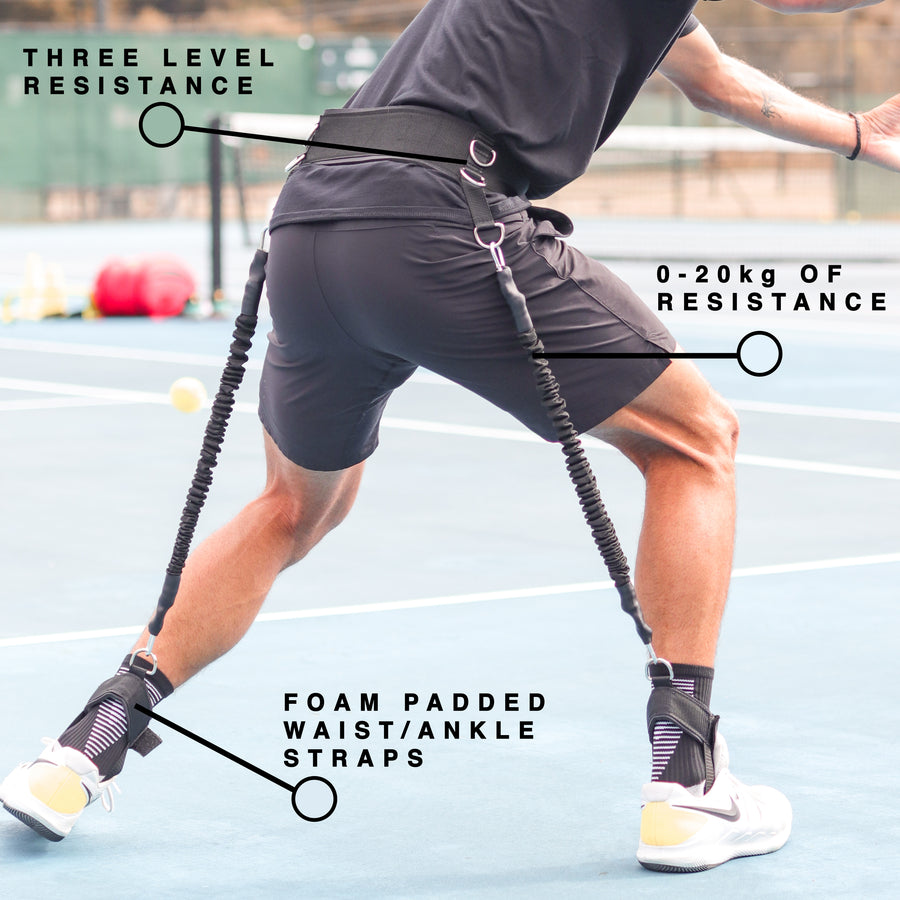
The XPAND Gravity Belt 2.0 is built around this principle. Worn during practice sessions, it creates real-time feedback around your hip and core positioning. When your centre of gravity rises inappropriately, you feel it immediately. Not as a punishment, as information. The kind of information your body can actually learn from across hundreds of repetitions.
Players who train with it consistently report that their ready position lowers naturally, even in matches when they're not wearing it. That's the goal. A habit that holds under pressure, not just in a controlled drill environment.
Applying This on Court: Drills That Reinforce the Position
Awareness training works best alongside purposeful practice. A few approaches that directly reinforce a low centre of gravity in tennis:
Shadow footwork with holds. Move through a standard footwork pattern, then pause at each recovery position and check your knee bend and hip height. Hold for two seconds before the next movement. This builds proprioceptive memory around what loaded actually feels like.
Split-step quality checks. During any ball-feed drill, focus entirely on your split-step landing. You should land with bent knees and immediate readiness to push off. If you land and then bend, the timing is off. Ask your coach or a practice partner to observe this specifically.
Wide ball recovery. Feed balls that force you wide, then prioritise your recovery position over your shot quality. The return matters far less than whether you're low and balanced when you hit. Train the positioning before the technique.
None of these drills are complicated. The discipline is in repeating them deliberately enough that the body internalises the pattern.
The Competitive Edge That Most Players Overlook
Technical improvements get a lot of attention. Players invest heavily in refining their topspin, their serve mechanics, their net game. All of that matters. But positioning is the platform everything else sits on.
A low centre of gravity in tennis gives you more time, better balance, and cleaner contact. It makes your footwork more efficient and your recovery faster. It keeps you in rallies that a slightly taller, more upright version of you would lose.
The players who move well and hold their structure under pressure aren't always the most talented. They're often just the most body-aware. That's a trainable quality, and it's one that serious players at every level can develop with the right approach.
If you're ready to make athletic positioning a genuine strength rather than an afterthought, explore how the Gravity Belt 2.0 fits into your training. The physical feedback it provides can accelerate the kind of habit change that coaching cues alone rarely achieve.