


tennis footwork drills
Struggling to move efficiently on court? Discover the tennis footwork drills serious players use to build speed, balance, and court coverage that holds under pressure.
Tennis Footwork Drills That Build Real Court Movement
You hit the ball well in practice. Your technique is sound, your racket preparation is clean, and your strokes feel comfortable when you have time. But in a real match, against a player who moves you around, things fall apart. Your shots lose depth. Your balance disappears. You start reaching instead of loading.
This is rarely a technique problem. It is almost always a movement problem.
Most club-level and competitive players underestimate how much their footwork dictates their ball-striking. When you arrive late, off-balance, or in the wrong athletic position, no amount of technical refinement will save the shot. Footwork is not a secondary skill in tennis. It is the foundation that everything else is built on.
The good news is that movement is trainable. But only if you are practicing the right things, in the right way, with the right level of intent.
Why Most Tennis Footwork Drills Miss the Point
Walk onto any club court during a training session and you will see footwork drills being performed with the body upright, weight on the heels, and minimal athletic engagement. Players shuffle through cone patterns, check the boxes, and move on. The drill gets done. The movement pattern does not actually change.
The problem is that footwork cannot be trained in isolation from athletic positioning. Speed through a ladder means nothing if you are not arriving into a low, balanced split step. Covering court quickly means nothing if your weight is loaded incorrectly when you prepare to strike.
Effective tennis footwork drills train the whole movement sequence — the read, the push, the travel, the setup, and the recovery — not just the travel portion in between.
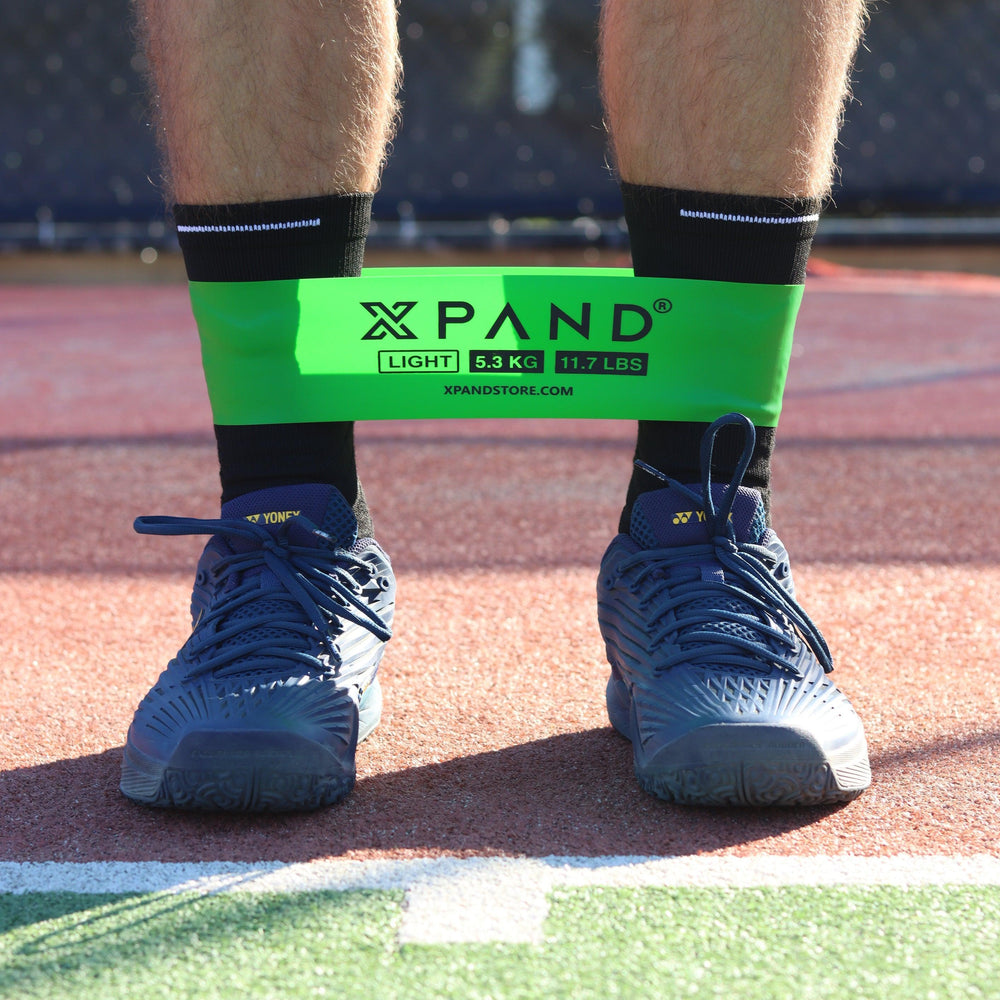
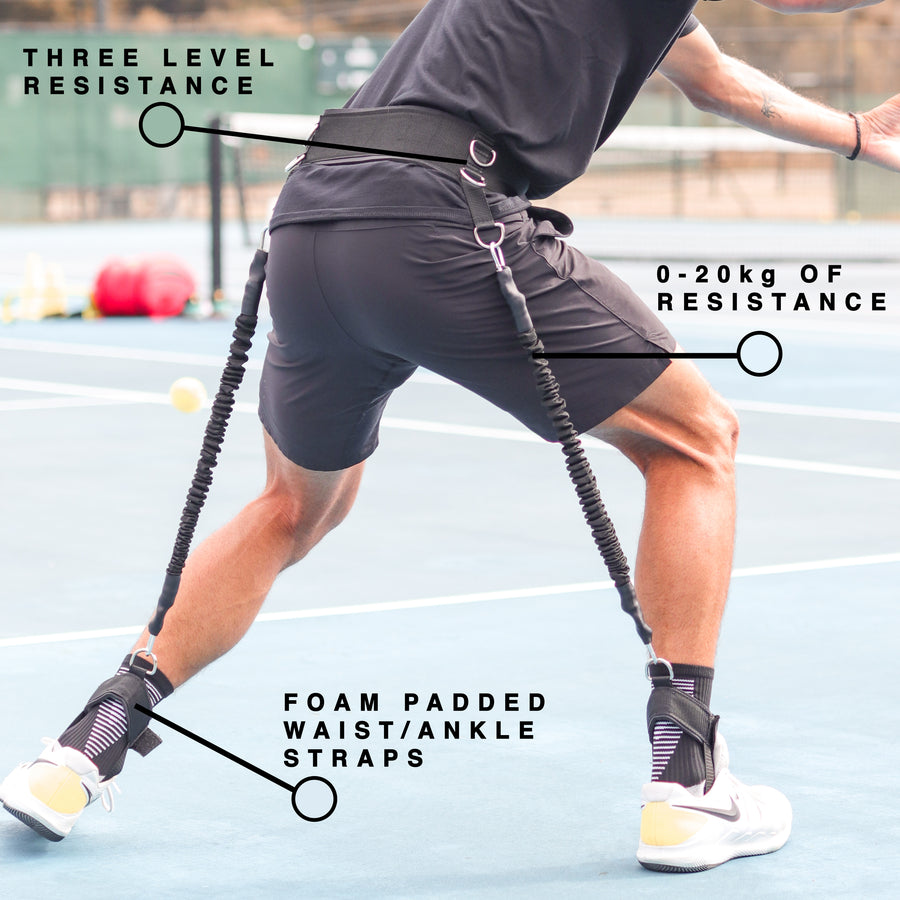
This is where a tool like the XPAND Gravity Belt 2.0 becomes genuinely useful. Using Reactive Neuromuscular Training, it creates light resistance through your movement patterns, forcing your body to engage the correct stabilising muscles and stay in proper athletic position throughout each drill. When the resistance is removed, the positioning holds because the body has been trained to maintain it, not just instructed to.
Four Footwork Drills Worth Doing Seriously
1. Split Step to Lateral Drive
Stand at the baseline in a neutral ready position. As you push into your split step, immediately drive laterally toward the singles sideline, covering five to six feet in two to three explosive steps. Focus on staying low through the entire movement. Your hips should remain below shoulder height. Reset and repeat in the opposite direction.
Most players cheat this drill by standing tall during the split and only dropping into position once they reach the ball. That timing is too late. The split step should already load you into the position you need. Do this drill at full intensity with short recovery intervals. Ten to twelve reps per side.
2. Cone Pattern with Deliberate Recovery
Place four cones in a box roughly three metres apart. Move through each cone in sequence — forward, lateral, diagonal, back — but treat each arrival as a full stop where you reset your base and check your weight distribution before moving to the next cone. This is not a speed drill. It is a positional awareness drill performed at controlled tempo.
The goal here is to develop the habit of arriving correctly, not just arriving quickly. Speed without position is not useful in match play.
3. Shadow Groundstroke Footwork
Without a ball, work through the full movement sequence for a forehand and backhand. A partner calls the shot, you split, push, move to the appropriate position, set your feet, swing through a full shadow stroke, and recover back to centre. The emphasis is on the recovery step. Most players stop once they have hit the imaginary ball.
Recovery footwork is where matches are won and lost, particularly at the club-competitive level where the point rarely ends after one ball.
4. Approach Shot Movement Pattern
Feed a short ball and practice the movement into the approach: a controlled push from the baseline, a transition through the service line with an open or semi-open stance, and immediate forward movement into a split at the net. The common error here is stalling after the approach shot. This drill builds the habit of continuous movement and positions you well for the volley.
How to Make Footwork Training Transfer to Match Play
The gap between drill performance and match performance comes down to one thing: whether your body has internalised the movement pattern or is simply executing it consciously when given time to think.
Internalisation happens through repetition under load, fatigue, and constraint. Training with the Gravity Belt 2.0 accelerates this process by making correct positioning the path of least resistance. Your body learns to stabilise, push, and arrive correctly not because you are thinking about it, but because the neuromuscular pattern has been reinforced hundreds of times.
Beyond that, the principle is straightforward. Keep your footwork drills specific to tennis movement patterns. Prioritise quality of position over speed of travel. Train recovery as much as approach. And do these drills regularly enough that your feet move before your conscious mind catches up.
The Player Who Moves Well Has More Options
There is a version of your game that exists when your footwork is no longer something you think about. Shots that felt rushed become comfortable. Defensive positions become neutral. Neutral becomes offensive. The player who moves well does not just cover more court — they have more time, more balance, and more choices on every single ball.
That player is built in practice, through drills done with intention and a training environment that reinforces correct positioning every time.
If you are serious about building movement that holds under match pressure, explore how the XPAND Gravity Belt 2.0 can support the way you train footwork. The difference is not always visible in the drill. It shows up in the third set.
```